
Search
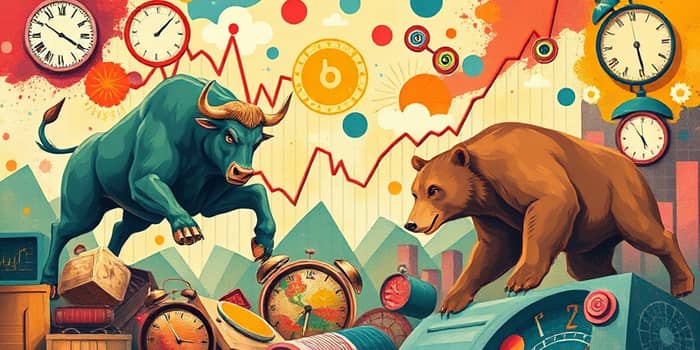
Markets have marched through booms and busts for centuries, leaving behind a tapestry of wisdom for every investor. Understanding these patterns can guide us through uncertainty and empower resilient decision-making.
At its core, a market cycle is a recurring sequence of gains and losses shaped by investor psychology, economic shifts, and policy moves. These cycles break down into four distinct phases:
While business cycles track expansions and recessions in real economy, market cycles often lead or lag these phases. A bull market can peak months before an official recession begins, as sentiment foreshadows deeper contractions.
Over the past 65 years, the S&P 500 has witnessed six major bull markets and six bear markets. Historical averages reveal striking contrasts:
Bear markets, though shorter, deliver more abrupt and painful declines. The 1973–74 bear dropped nearly 48%, while the 2008 financial crisis erased more than half of market value. In contrast, extended bull runs—such as the 1990s tech rally—can fuel extraordinary gains exceeding 500%.
Sector performance varies widely across regimes. Commodities tend to excel when inflation and rates rise, while bonds underperform. Technology stocks dominated the 2009–2020 expansion, illustrating how innovation can amplify cyclical strength.
History offers timeless lessons that investors can apply today. By studying past booms and busts, we can decode the forces that propel markets:
Consider the 2000 dotcom crash versus the 2008 financial crisis. Both featured price excesses and leverage, yet the former was fueled by speculative tech valuations, while the latter stemmed from systemic credit failures. Policy tools and market structure also evolved, yielding distinct recovery paths.
Longer secular trends overlay these shorter cycles. Generational theories such as the Fourth Turning propose 80–100 year mega-cycles, while Kondratiev waves suggest 40–60 year economic fluctuations driven by technological revolutions. Though debated, these frameworks remind us to keep a multi-horizon perspective.
Decoding cycles isn’t mere academic exercise—it anchors practical strategies and risk management. Here are proven approaches:
Investors can further refine timing by watching credit spreads, yield curves, and economic indicators such as industrial production and consumer confidence. These gauges often anticipate inflection points.
Discipline is equally vital. Chasing the last leg of a rally or panicking in a sell-off compounds losses. A disciplined plan with predefined rebalancing rules and cash buffers helps withstand volatility.
Today’s environment presents unique challenges: elevated debt levels, demographic shifts, rapid technological change, and evolving policy frameworks. Yet, the core principle remains: cycles reflect the interplay of human emotion, capital flows, and economic fundamentals.
Investors who study history gain an edge in anticipating potential regime shifts and aligning portfolios accordingly. Building resilience through diversification, maintaining liquidity for opportunistic buys, and adhering to a long-term vision can turn market turbulence into advantage.
Remember that bear markets, though daunting, often set the stage for the most powerful bull runs. Patient accumulation of quality assets during downturns can yield outsized rewards.
Decoding market cycles empowers you to approach investing with clarity, confidence, and conviction. By blending historical insights, analytical tools, and disciplined execution, you can navigate any phase with purpose and poise.
Embrace the lessons of the past to chart a resilient path forward, and let every cycle—bull or bear—fuel your journey toward lasting financial success.
References