
Search
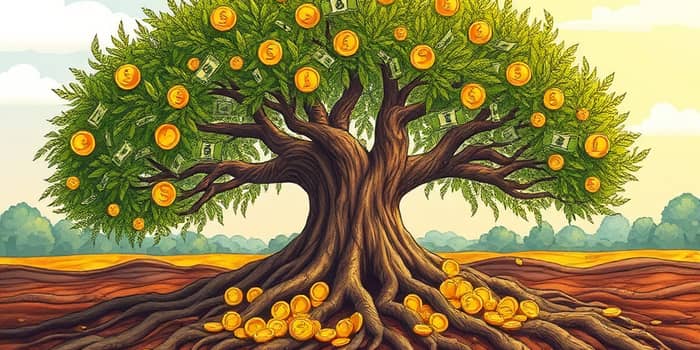
The journey from modest savings to a substantial nest egg is rarely a sprint; it’s a marathon powered by time and consistency. When you embrace the exponential growth potential of compound interest, even small contributions begin to snowball into life-changing wealth. This article delves deep into the mechanics, real-world examples, and practical strategies to ensure you harness this financial superpower over decades.
At its core, compound interest is the process where interest is added both to the original principal and to previously earned interest. This creates an ever-expanding base on which future interest is calculated. Unlike simple interest, where you earn a fixed percentage only on the initial amount, compound interest rewards patience by letting your money work on itself.
Mathematically, the compound interest formula is A = P (1 + r/n)^(n t), where:
With each compounding interval, interest added to both principal and earned returns accelerates growth. Over long time horizons, this compounding effect becomes nothing short of magical.
Concrete examples illustrate why early and steady investing is crucial. Consider a $10,000 deposit at 4% annual interest, compounded daily, with no further contributions:
Scaling up, a $100,000 investment over 10 years at a fixed rate shows how different compounding frequencies influence your outcome:
While the differences may appear modest over a decade, those extra percentages translate into thousands of additional dollars—and over multiple decades, the gap widens dramatically.
The real magic of compounding emerges when you extend your horizon beyond ten years. With average annual returns of 9–10% (as the S&P 500 has historically delivered since 1928), even modest annual contributions can mushroom into significant wealth. If you invest $5,000 every year for 30 years at a 9% compounded rate, you'll accumulate over $600,000, whereas simple accumulation without compounding would yield less than half that amount.
These numbers exemplify why small initial contributions can have outsized effects when given enough time. Missing just a few early years means losing not only contributions but decades of exponentially growing interest.
Compounding can occur at various intervals—annually, semi-annually, quarterly, monthly, daily, or even continuously. Increasing frequency yields a higher effective rate:
At the theoretical extreme, continuous compounding follows the formula A = P × e^(r t), where e is approximately 2.71828. Though the gains over daily compounding are marginal, the concept highlights that any increase in compounding frequency contributes to incremental growth.
Over multiple decades, even fractional advantages multiply. When comparing continuous compounding to annual compounding for 30 years at a 7% rate, continuous methods can boost your ending balance by several percentage points—translating to tens of thousands of extra dollars.
Despite the clear benefits, many investors falter due to psychological biases. We undervalue long-term gains because our brains are wired for immediate rewards. Yet, understanding and overcoming these pitfalls can dramatically enhance your financial outcomes.
Maintaining discipline is often the greatest challenge. By recognizing that returns building upon themselves each year create lasting wealth, you reinforce the importance of consistency over chasing short-term gains.
Compounding is more than a financial formula; it’s a testament to the transformative power of time and consistency. When you commit to an investment plan and let your earnings reinvest year after year, you harness one of the most potent forces in finance.
Whether you’re saving for retirement, a child’s education, or a dream project, remember that patience is your greatest ally. By starting early, staying disciplined, and understanding the mechanics behind compounding, you ensure that even modest savings can become substantial fortunes over decades.
Embrace this principle now, and watch as time amplifies the effect of every dollar you invest—turning small seeds of savings into a flourishing forest of financial security.
References