Search
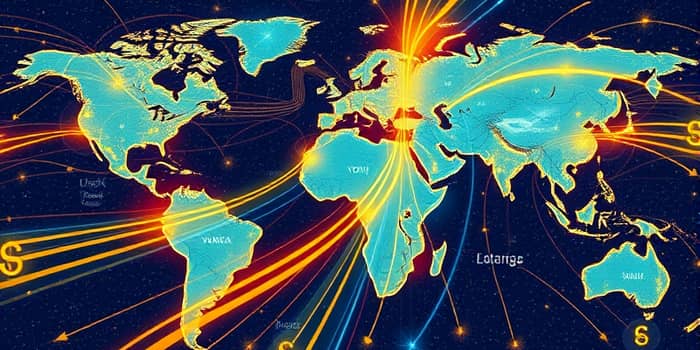
In an increasingly interconnected world, the movement of capital across borders shapes economies, influences policy, and creates opportunities for growth. From bustling financial centers to emerging markets, understanding where money is moving—and why—empowers investors, policymakers, and entrepreneurs to make informed decisions.
This article delves into the definitions, trends, risks, and practical insights surrounding global capital flows in 2025, providing you with a roadmap to navigate this dynamic landscape.
At its core, capital flows refer to the movement of money for investment, trade, or business production across borders. These flows can be split into several categories:
Each type serves different purposes. Portfolio investments offer liquidity and diversification, while direct investments often drive long-term growth through infrastructure or corporate expansion. Banking flows facilitate cross-border lending and deposits, and sovereign wealth funds can sway markets with large-scale allocations.
For decades, the United States and Western Europe dominated global capital flows. Today, the system is evolving into a polycentric financial power structure, with new hubs emerging in India and the Middle East. Abu Dhabi Global Market and Dubai International Financial Centre are attracting institutional capital with free zones, robust regulation, and modern infrastructure.
As traditional pull factors—such as low interest rates and macroeconomic stability—are joined by aggressive efforts from emerging centers, capital is increasingly mobile. India’s economic reforms and the UAE’s strategic positioning at the crossroads of Asia, Africa, and Europe are prime examples of how diverse centers can coexist in a modern financial ecosystem.
The latest figures highlight the scale and direction of global capital movements. In May 2025, U.S. Treasury data reported a remarkable:
Meanwhile, emerging markets saw their first net capital outflows since early 2020 in Q4 2024, driven by declining non-resident investments. China experienced rising resident outflows even as portfolio inflows rebounded, illustrating how domestic factors can reshape global trends.
Across industries, some sectors are magnets for funding:
After a period of stagnation due to interest rate hikes, real estate markets are witnessing renewed transaction activity. Institutions are increasing allocations as borrowing costs stabilize, unlocking liquidity cycles and boosting confidence in transparent markets.
Meanwhile, meeting net-zero goals will require roughly $6.5 trillion per year in infrastructure investment by 2050. Digital infrastructure—such as data centers powering AI and cloud services—benefits from nearly $33 trillion in global trade volume recorded in 2024.
Capital flows are propelled by a mix of push and pull factors. While developed economies’ monetary policies and interest rate landscapes remain influential, emerging markets are actively courting funds through incentives and regulatory reforms.
However, significant risks persist. Sudden policy shifts in major economies can trigger abrupt outflows, posing threats to financial stability in vulnerable regions. Geopolitical tensions, trade volatility, and energy price fluctuations add layers of uncertainty.
Investors must watch macro indicators—such as interest rate changes and supply chain realignments—to anticipate and mitigate potential shocks. Policy makers, in turn, should cultivate resilience by maintaining transparent regulations and diversifying funding sources.
How can stakeholders harness these insights?
Institutional investors should diversify across polycentric hubs and seek stable returns in emerging markets. Entrepreneurs can focus on sectors with robust inflows—especially digital and clean energy. Individuals gain by understanding the influence on currency and exploring global ETFs or property funds.
Capital flows are more than numbers on a balance sheet; they reflect human ambition, technological progress, and global collaboration. By studying these movements, we gain foresight to build resilient economies, foster sustainable development, and unlock shared prosperity.
As you engage with this dynamic landscape, remember to harness them for collective prosperity and think globally and act locally. In doing so, you become part of a story that transcends borders and drives positive change for communities worldwide.
References