
Search
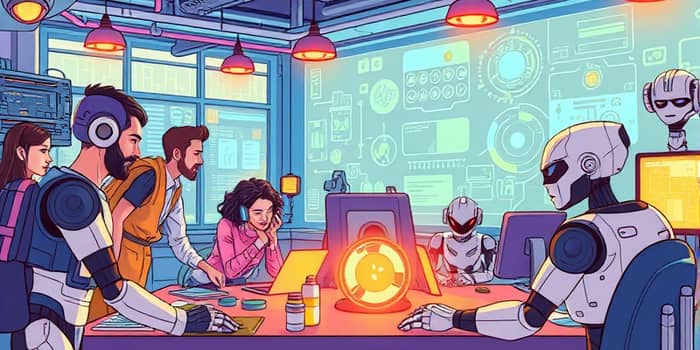
The dawn of artificial intelligence and advanced robotics heralds a profound transformation of the global labor market. As machines become more capable, businesses and individuals face both daunting challenges and unprecedented opportunities. This article delves into the numbers, explores sectoral shifts, and offers practical guidance on navigating the evolving world of work.
By 2025, up to 85 million jobs will be displaced by AI, yet a surge of innovation is poised to create 97 million new roles globally. Forecasts extend to 2030, predicting up to 92 million roles may be automated alongside a net gain of 78 million new positions. In total, an estimated 300 million jobs—about 9.1% of global employment—face varying degrees of automation risk.
Automation does not strike uniformly. Routine, repetitive positions bear the highest risk, while complex, judgment-driven roles are more insulated. The following table outlines vulnerability categories:
Demographic impacts unfold unevenly. In the U.S., nearly 59 million women and 49 million men occupy roles highly exposed to AI. Entry-level professionals feel the pinch: tech firms cut new grad hiring by 25% in 2024 compared to the previous year, while nearly half of Gen Z believe AI has devalued their degrees.
Despite displacement fears, automation promises to boost prosperity. Estimates suggest AI could contribute 1.2% annual GDP growth if fully harnessed. Industries most exposed to AI have seen revenue per worker nearly quadruple since 2022. Meanwhile, chatbots alone have saved businesses over $8 billion annually.
These gains underscore a vital truth: productivity advances can create wealth that fuels new sectors, services, and career paths—provided that the benefits are shared equitably.
Rather than wholesale replacement, many leaders view automation as augmentation. Machines excel at pattern recognition and repetitive tasks, freeing humans to focus on creativity, complex problem-solving, and interpersonal skills. To seize these advantages, organizations must invest in upskilling and cultural change.
Governments, corporations, and educational institutions must coordinate to manage transition risks. Key strategies include:
1. Launching nationwide reskilling and retraining programs that target high-risk populations.
2. Encouraging businesses to adopt human-centric AI frameworks that blend automated systems with human judgment and oversight.
3. Adjusting educational curricula to prioritize lifelong learning, digital skills, and critical thinking from an early age.
Without swift action, we risk exacerbating social inequality and leaving vulnerable workers behind just as the next wave of technological change arrives.
The future of work extends beyond economics. Ethical considerations—AI fairness, data privacy, and governance—must guide development to ensure machines enhance human dignity rather than undermine it. Moreover, global disparities demand attention. North America and Europe may lead in AI adoption, but offshoring trends shift white-collar jobs to lower-wage regions, raising questions about equity and representation.
As work evolves, so does the fabric of society. Ensuring mental health, work-life balance, and social mobility in a highly automated world requires novel policy frameworks, corporate responsibility, and individual adaptability.
The narrative of automation is neither wholly bleak nor uniformly bright. It is a story of transformation—of routine tasks ceded to machines and new avenues opened for human ingenuity. By acknowledging the risks, investing in people, and upholding ethical standards, we can shape a future where technology amplifies our potential and redefines work for the better.
Now is the moment for leaders, educators, policymakers, and workers to unite around a shared vision: a future of work that drives economic prosperity, promotes social equity, and celebrates human creativity in partnership with intelligent machines.
References